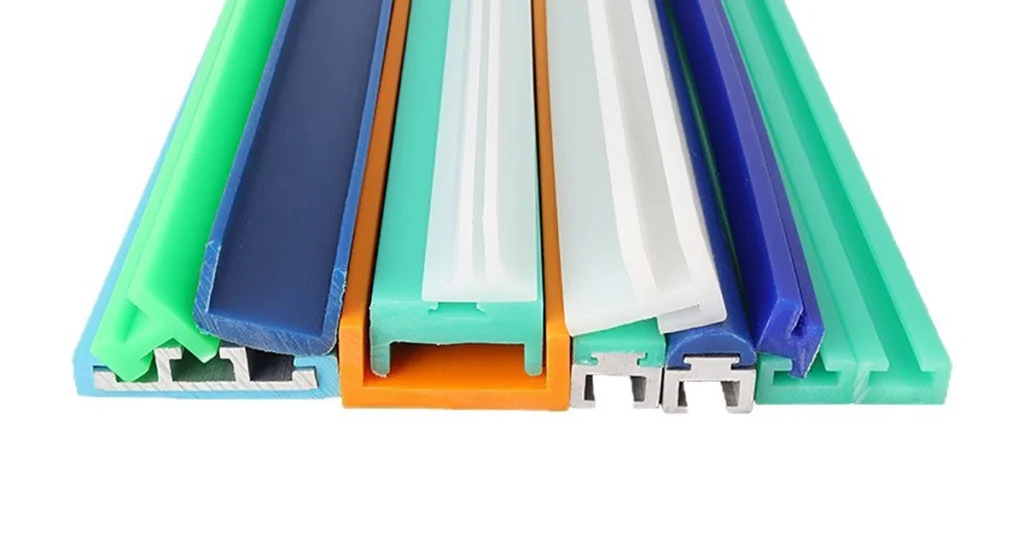

In high performance industrial manufacturing, a single plastic resin rarely has all of the mechanical, optical and structural properties required for a complicated application. Materials used for rigid load-bearing frames generally lack the flexibility to provide gasketing, vibration damping, or environmental sealing. Conversely, elastomeric materials that are great at sealing cannot maintain long-length dimensional alignment by themselves.
Product designers have traditionally resolved this problem by obtaining separate rigid and flexible parts, and putting them together on assembly lines using adhesives, mechanical fasteners, or manual insertion. Today, multi-material co-extrusion and tri-extrusion technologies eliminate these additional manufacturing stages. Engineers can create multi-functional, hybrid profiles in a single continuous pass by integrating distinct polymer streams inside a single precision die.
Introduction: Moving Beyond Single-Material Limits with Multi-Extrusion
What is co-extrusion and tri-extrusion? Merging different polymer streams into a single profile
Co-extrusion and tri-extrusion are processes where two or three separate extruders are run simultaneously into a specific, multi-manifold extrusion die. Within the tool, different temperature and pressure profiles are applied to each polymer melt stream, which are then rejoined just before passing through the final size orifice.
    Extruder 1 (Rigid Core / Base) ------+
                                         |
                                         |---> [Multi-Manifold Co/Tri Die] ---> Monolithic Hybrid Profile
    Extruder 2 (Flexible TPE / Gasket) --+
    Extruder 3 (UV Barrier / Cap Layer) -+  (Tri-Extrusion Option)
When the resins come together under high pressure, the interface of the two resins crosslinks at a molecular scale, forming a permanent weld between the components. This results in a continuous profile that is ejected from the die as a single piece, uniting different physical zones, without the need of mechanical clips or glues.
The engineering breakthrough of uniting rigid structures and soft sealing elements in one pass
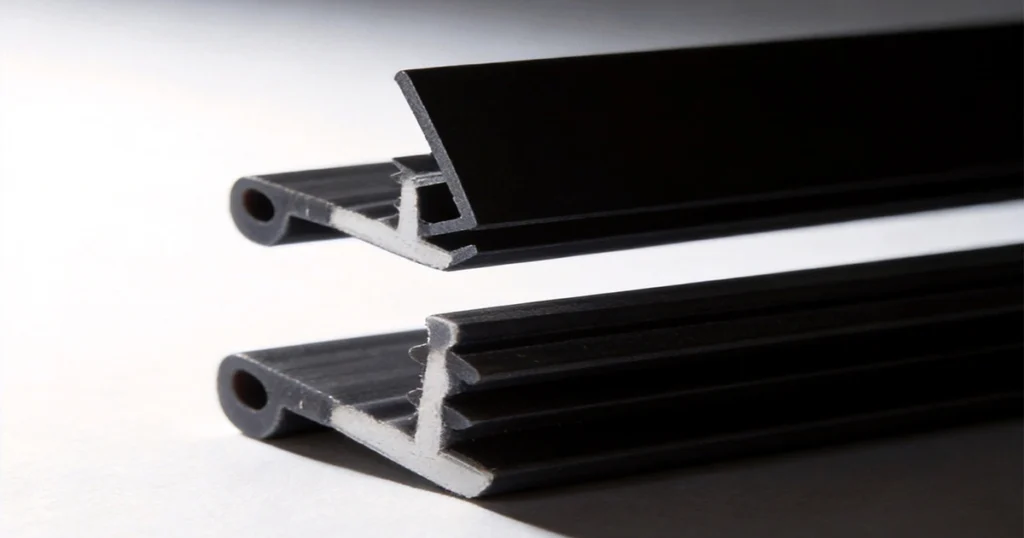
This ability of multi-extrusion is a great step forward in component design. Instead of trading off rigidity and flexibility, product engineers can design a profile with:
A rigid base skeleton to keep it all aligned and snap firmly into metal or wood frames.
Soft elastomeric sealing lips or fins that compress against mating surfaces to block dust, water and air infiltration.
A third functional layer (in tri-extrusion), e.g., a high gloss cosmetic cap, a UV-blocking barrier, or an anti-static surface layer.
The Mechanics of Co-Extrusion: Combining Rigid Bases with Flexible TPE
Utilizing rigid PVC or polycarbonate for structural load-bearing and mounting stability
The structural core of a multi-durometer profile relies on high modulus thermoplastics. The extrusion is based on Rigid Polyvinyl Chloride (uPVC), Polycarbonate (PC), Acrylonitrile Butadiene Styrene (ABS) or High-Impact Polystyrene (HIPS):
Structural Integrity: Maintains tight tolerances over continuous multi-meter runs without sagging or twisting.
Mechanical Retention: Enables profiles to be designed with robust snap-fit legs, barbed mounting stems, or screw channels for a secure locking into receiving housings.
Thermal Resistance: Prevents cross-sectional collapse from operational heat sources or external ambient temperatures.
Integrating soft thermoplastic elastomers (TPE) or rubber-like lips for sealing, cushioning, and grip
Simultaneously, flexible polymers are extruded directly onto the selected edges or functional faces of the rigid substrate. Flexible polymers can be Thermoplastic Elastomers (TPE), Thermoplastic Vulcanizates (TPV) or flexible PVC.
Dynamic Sealing Fins: Flexible TPE lips adjust to surface imperfections on mating panels, providing airtight and watertight sealing.
Anti-Slip Friction Strips: Rubberized patches co-extruded on the underside of rigid tracks to avoid sliding on glass, metal or glossy wood surfaces.
Impact Cushioning: Soft bumper layers co-extruded on exposed profile corners absorb kinetic shock and prevent chipping or denting.
To explore how multi-material compounding can solve your specific structural and sealing challenges, discover our specialized custom profile tooling and plastic extrusion capabilities.
Engineering Advantages: Eliminating Secondary Assembly and Enhancing Performance
Cutting labor costs by replacing manual glue-bonding or tape-application with one-piece extrusion
Traditional manufacture requires dedicated factory floor space, physical work, and curing time to attach flexible gaskets to hard plastic or aluminum frames:
Multi-meter lengths should be treated with liquid adhesives or double-sided acrylic tapes.
Workers manually press rubber seals onto the rigid track, which might cause stretching, misalignments or localized debonding.
Solvent-based glues can release volatile organic compounds (VOCs) and may leave a visible residue on cosmetic surfaces.
Co-extrusion eliminates these secondary operations entirely. Components exit the extrusion line completely constructed and ready for rapid installation, reducing unit labor costs and speeding manufacturing throughput.
Achieving superior IP-rated waterproofing, vibration damping, and anti-slip friction properties
Co-extruded materials fuse at a molecular scale while still in a molten state, therefore the link between hard and soft zones is continuous and homogenous:
Zero Micro-Gaps: Eliminates miniscule passageways where moisture or high-pressure water jets could penetrate, making co-extruded profiles excellent for IP65, IP67, and IP68 waterproof enclosures.
Vibration Isolation: The flexible TPE portion acts as an integrated damping pad to isolate mechanical noise and vibration in HVAC ducting, vehicle trim and architectural door frames.
Custom Co-Extrusion Case Studies: Solving Complex Thermal and Functional Challenges
Managing differential thermal shrinkage rates between diverse polymer layers during cooling
Extruding dissimilar polymers together presents significant engineering challenges. Different plastics have different melting temperatures, flow viscosities and coefficients of thermal contraction:
If the cooling process in vacuum calibrators and water baths is not controlled accurately, the flexible layer shrinks faster than the rigid base, causing the finished profile to bow, twist or delaminate along the bond line.
Tooling engineers get around this by computing differential contraction rates during mold design. They use multi-stage vacuum sizing tanks and zonal temperature control to ensure that both layers of material harden evenly without creating internal stresses.
Innovative multi-material applications in automotive, window seals, and LED housing frames
Multi-extrusion technology enables specialized applications across diverse industries:
Automotive Glass & Door Seals: Tri-extruding a rigid mounting spine, a sponge-rubber sealing bulb, and a low-friction flocking coating into a single weatherstrip profile.
Energy-Efficient Window Framing: Combining rigid uPVC frame profiles with co-extruded flexible TPE weatherstripping lips to prevent air leakage in green building facades.
Architectural LED Profiles: Co-extruding a rigid base housing of opaque with soft, flexible mounting wings and an optical-grade light-diffuser window into a seamless unit.
To consult with our engineering team, submit your CAD drawings for a DFM evaluation, or request multi-material samples, learn more about our custom plastic extruded profile manufacturing.